7 Aug 2026
Technical Approaches to Alias Encoding in Localized Gaming Roster Systems
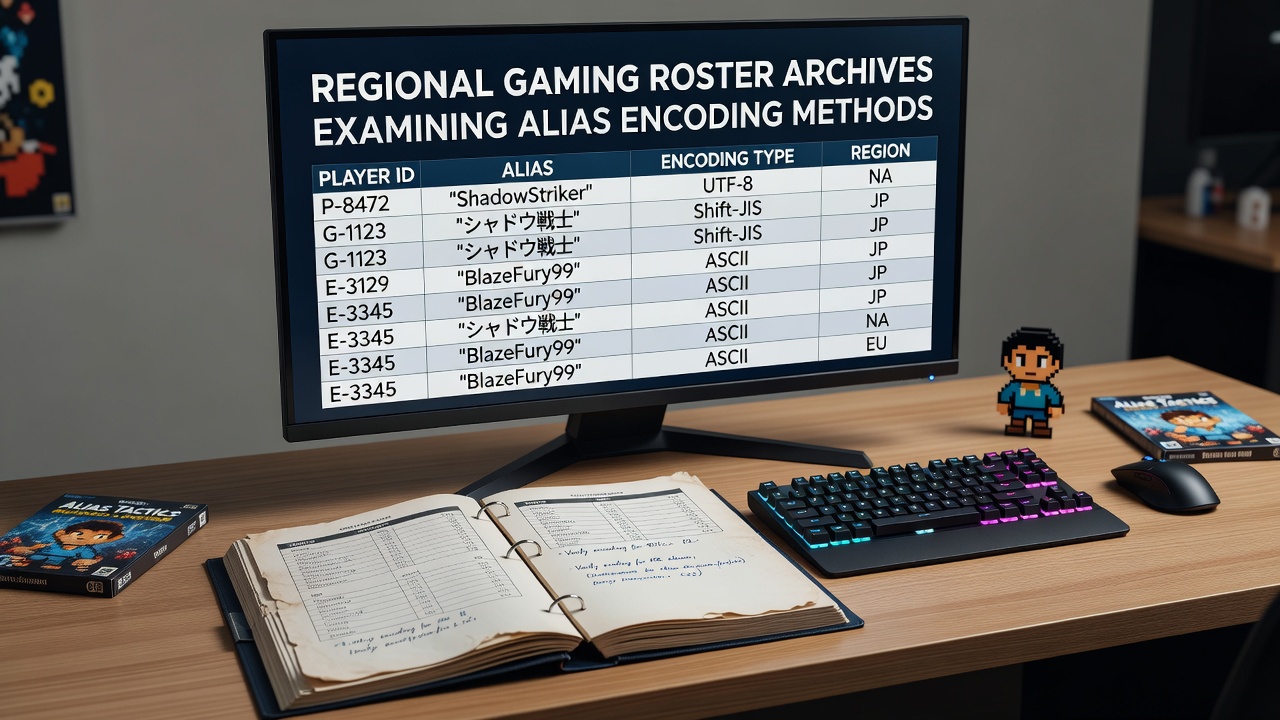
Regional gaming roster archives maintain extensive collections of player aliases that require consistent encoding to support multiple languages, special characters, and historical data formats, while researchers note that these systems often combine Unicode standards with legacy character mappings to preserve compatibility across different platforms and time periods. Data from international gaming organizations indicates that effective alias handling prevents corruption during transfers between regional servers and central databases, and experts have observed that variations in encoding practices emerge most clearly when archives span multiple decades of player activity.
Core Character Encoding Standards in Use
Unicode Transformation Format 8 serves as the primary method in modern roster systems because it accommodates Cyrillic, Latin, and East Asian scripts without data loss, whereas older archives frequently rely on ISO-8859 variants or Windows-1251 for Eastern European entries. Studies from academic computing departments show that UTF-8 adoption accelerated after 2015 as cross-border tournaments increased, yet many legacy files still undergo conversion routines during ingestion to avoid mojibake artifacts that distort player names. Observers note that regional differences persist, with North American systems favoring ASCII extensions early on while Asian archives integrated GBK and Shift-JIS mappings alongside Unicode for broader coverage.
Compression and Obfuscation Techniques
Archive maintainers apply base64 encoding to store aliases containing restricted symbols or to reduce storage overhead in high-volume leaderboards, and this approach allows binary-safe transmission through text-based protocols common in older gaming networks. Research indicates that custom hashing layers sometimes overlay primary encodings to enable quick lookups while shielding original strings from direct inspection, although full reversibility remains essential for verification tasks. Those who manage large-scale collections report that selective compression works best when applied after character normalization, which eliminates duplicate representations of the same alias across different code pages.
Regional Variations and Archive Integration
European gaming databases often integrate EU data protection guidelines when encoding player information, which influences how aliases containing personal references are stored and retrieved. Australian industry reports highlight similar practices that combine local character sets with international standards to support both domestic and imported rosters. In August 2026 several major archives completed migration projects that standardized UTF-8 across previously fragmented regional collections, resulting in improved search accuracy for historical player data. People who examine these updates find that automated scripts now detect and correct encoding mismatches during bulk imports, reducing manual review time significantly.

Japanese and Korean roster systems demonstrate hybrid encoding where legacy JIS and EUC formats feed into UTF-8 pipelines, and this layered method preserves exact original strings for audit purposes while enabling modern display. Canadian research institutions have documented similar transitions in North American archives, where early ASCII limitations gave way to full Unicode support following increased participation from international players. The process typically involves normalization steps that strip combining characters before final storage, which prevents lookup failures caused by visually identical but technically distinct aliases.
Challenges in Cross-Archive Data Exchange
Transfers between regional systems frequently encounter encoding conflicts when one archive uses strict UTF-8 and another retains legacy mappings, leading developers to implement detection algorithms that analyze byte patterns before conversion. Industry groups such as the International Game Developers Association have published guidelines on handling these mismatches, and figures from their technical committees reveal that proper normalization reduces error rates by measurable margins during large-scale merges. Those managing ongoing projects observe that maintaining bidirectional mapping tables remains critical for any archive that accepts contributions from multiple geographic sources.
Future Directions for Encoding Practices
Continued growth in global player bases drives adoption of newer Unicode revisions that include additional scripts and emoji support relevant to gaming communities, while existing archives undergo periodic audits to ensure compatibility. Academic papers from universities across Asia and Europe outline potential improvements in encoding efficiency through machine-learning-assisted detection of legacy formats. The reality is that standardized practices across regions continue to evolve as new data arrives and older collections receive updates, with particular attention paid to preserving historical alias integrity during each transition.
Conclusion
Encoding methods within regional gaming roster archives reflect a balance between legacy constraints and modern Unicode requirements, and the documented approaches ensure reliable storage and retrieval across diverse linguistic contexts. Continued refinement of conversion tools and adherence to established technical standards support ongoing expansion of these collections without loss of original player information.